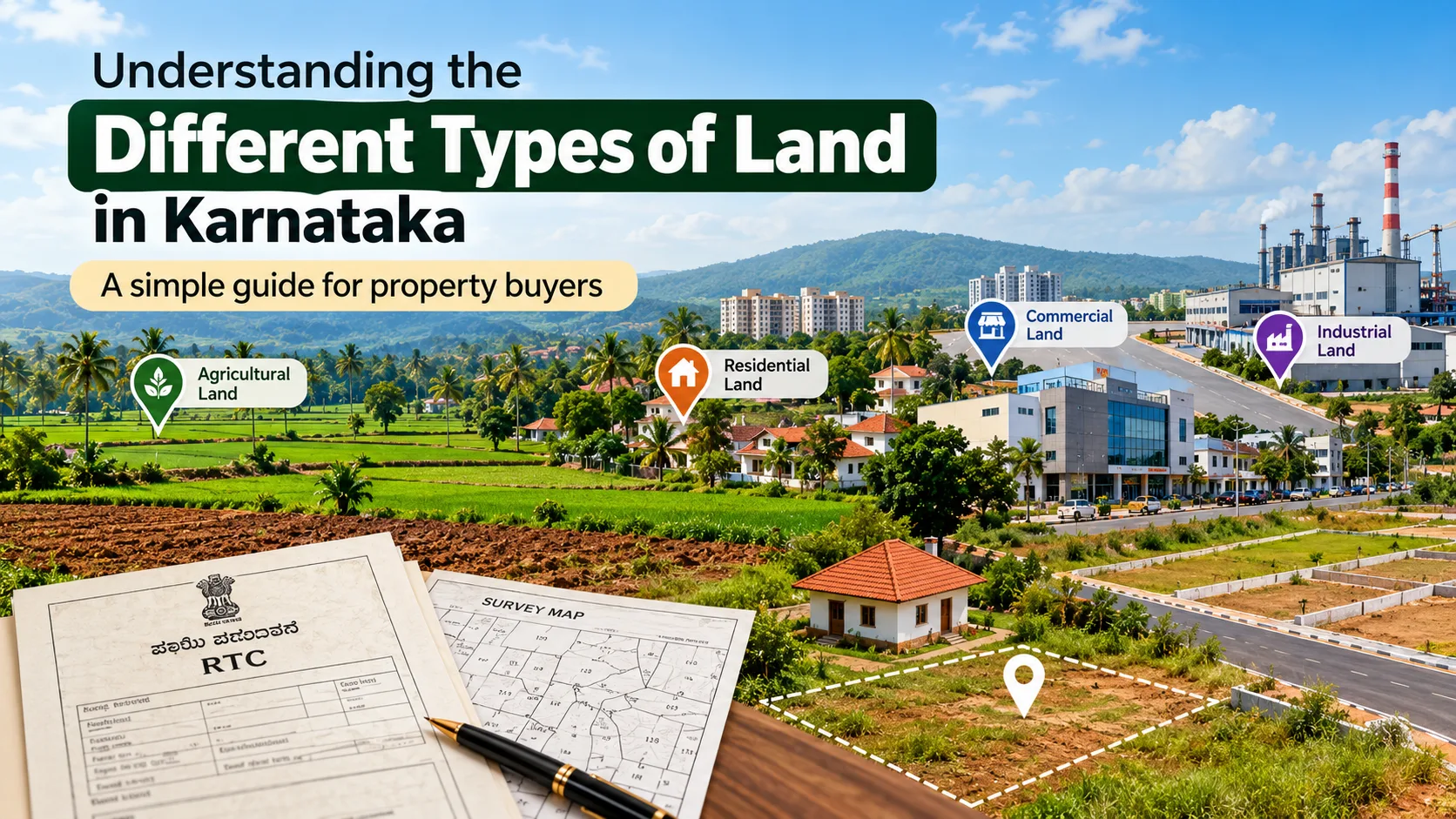
Major Types of Land in Karnataka
Understand the type of land before buying & selling
1. Agricultural Land
- Dry Land
- Wet / Irrigated Land
- Garden Land
- Plantation Land
Land primarily used for cultivation and agricultural activities.
2. Converted Land
- Residential use
- Commercial use
- Industrial use
Agricultural land converted for non-agricultural purposes.
3. Granted Land
Land granted by the government to eligible persons/beneficiaries.
Check the Grant Conditions and whether the PTCL Act applies before purchasing.
Check the Grant Conditions and whether the PTCL Act applies before purchasing.
4. Government Land
Land owned or controlled by the Government.
5. Gomal Land
Government land reserved for grazing livestock.
6. Kharab Land
- A-Kharab
- B-Kharab
Land that is unsuitable or unavailable for agricultural cultivation.
7. Gramathana Land
Land located within the village habitation/residential area.
8. Forest Land
Land falling under the jurisdiction of the Forest Department.
9. Bagair Hukum Land
Government land being cultivated/occupied without formal authorization. Its eligibility for regularisation must be verified according to the applicable rules.
10. Inam Land
Land historically granted for service, religious or other specific purposes.
11. Devalaya / Muzrai Land
Land belonging to a temple or religious institution.
12. Waqf Property
Property dedicated or registered for Waqf purposes.
13. P-Number Land
Land identified with a P-Number, generally associated with a survey/subdivision process.
14. Layout / Site Land
Land developed into sites/plots as part of a layout, subject to the applicable approvals.
Documents / Records to Check Before Buying Land
RTC → Mutation (MR) → Grant Records → Conversion Order → Survey Records → EC (Encumbrance Certificate) → Title Deeds
Also check:
- Litigation
- Acquisition
- PTCL Act
- Master Plan / Land Use
Note: The poster is educational in nature; the exact legal status and restrictions of a particular property should be verified from the relevant government records and applicable laws.
Understanding the Different Types of Land in Karnataka
Buying land in Karnataka is not simply about checking the location, size and price. Land records can describe property in different ways, and each classification can have different implications for its use, transfer and development.
Terms such as agricultural land, converted land, granted land, government land, kharab land, gomal land, Bagair Hukum land and Gramathana land are commonly encountered when examining revenue records.
Here is a simple explanation of the major types.
1. Agricultural Land
Agricultural land is land recorded primarily for agricultural use. It may be used for cultivation, plantations, horticulture or related agricultural activities.
Depending on the nature of the land and local records, you may come across descriptions such as dry land, wet/irrigated land, garden land and plantation land.
If you intend to construct a house, commercial building or other non-agricultural development, you should not assume that agricultural land can automatically be used for that purpose. The applicable land-use and conversion requirements need to be checked. The Karnataka Land Revenue Act regulates the use and conversion of agricultural land.
Before buying: Check the RTC, survey records, land-use status and whether the proposed use is legally permissible.
2. Converted Land
Converted land generally refers to agricultural land that has been permitted to be used for a non-agricultural purpose.
Depending on the approval and applicable planning regulations, the intended use may be residential, commercial, industrial or another permitted use.
Conversion, however, does not by itself mean that a parcel is automatically an approved residential site or building plot. Planning approval, layout approval, zoning and building permissions may also be relevant.
Before buying: Verify the conversion order and confirm that the proposed use matches the applicable planning and local-authority permissions.
3. Granted Land
Granted land is land that has been granted or allotted by the Government, often subject to specific conditions.
A particularly important category involves land granted to members of Scheduled Castes and Scheduled Tribes. Karnataka's SC/ST (Prohibition of Transfer of Certain Lands) Act, 1978 provides restrictions concerning certain granted lands and provides for restoration in specified circumstances.
Therefore, a property described as "granted land" requires considerably more examination than simply checking the current owner's sale deed.
Before buying: Examine the original grant order, grant conditions, subsequent revenue records and the applicability of any restrictions such as the PTCL legislation.
4. Government Land
Government land is land belonging to or vested in the Government.
Examples can include various categories of public land, roads, water bodies, reserved land and other government properties.
The fact that somebody is occupying or cultivating government land does not by itself establish private ownership. Some government land may have been legally allotted or regularised under specific schemes, but that must be established from official records.
Before buying: Confirm the ownership and classification in official revenue records. Do not rely solely on possession.
5. Gomal Land
Gomal land generally refers to government land reserved for grazing livestock and related community purposes.
Because its purpose is connected with common or public use, it should not be treated as ordinary private agricultural land simply because somebody is occupying or cultivating it.
Before buying: Verify the revenue classification and whether there has been any lawful change in its status.
6. Kharab Land — A-Kharab and B-Kharab
The term kharab is commonly encountered in Karnataka land records in connection with portions of survey land that are treated differently from the cultivable portion.
You may encounter references to A-Kharab and B-Kharab. The exact legal and revenue implications depend on the applicable records and circumstances.
A common mistake is to assume that every portion shown as kharab is automatically available for private development or sale.
Before buying: Examine the survey sketch, RTC, phodi/survey records and the nature of the kharab classification rather than relying on the total survey-area figure alone.
7. Gramathana Land
Gramathana refers broadly to land within the traditional village habitation area.
Such properties may contain houses and other structures and can have a different record history from agricultural survey land outside the habitation area.
When purchasing a Gramathana property, it is important to establish the identity of the property, boundaries, ownership and applicable local planning/building regulations.
Before buying: Check the relevant village/local records, title documents, survey details and permissions applicable to the property.
8. Forest Land
Forest land is land that falls within the applicable forest classification or is under the control/jurisdiction of the Forest Department.
Such land cannot simply be treated as ordinary private property because someone has been occupying it for a long period.
Forest-related restrictions can be significant, particularly when construction, development or change of use is proposed.
Before buying: Verify the land's classification and whether it falls within any notified forest or protected area.
9. Bagair Hukum Land
Bagair Hukum generally refers to cases involving occupation or cultivation of government land without an original lawful grant or permission.
Karnataka has had various schemes and statutory provisions dealing with the regularisation of certain unauthorised occupations, subject to eligibility and conditions.
However, an application for regularisation is not the same as ownership.
Before buying: If a property has a Bagair Hukum history, verify the regularisation proceedings, orders and current revenue records before considering a purchase.
10. Inam Land
Inam land has historical origins in grants made for particular services, religious purposes or other purposes under earlier systems of land administration.
Karnataka has enacted legislation abolishing or regulating different categories of Inams. For example, the India Code records separate legislation relating to religious and charitable Inams.
Consequently, an old document referring to an "Inam" grant can require examination of the historical title and subsequent proceedings.
Before buying: Trace the title from the original Inam/grant records through subsequent orders and revenue entries.
11. Devalaya / Muzrai Land
This refers to land associated with a temple or Hindu religious institution/charitable endowment.
Karnataka has specific legislation governing Hindu religious institutions and charitable endowments.
Such property should not be treated like an ordinary privately owned property merely because an individual is shown as being in possession.
Before buying: Establish who legally owns or administers the property and whether any statutory restrictions apply to its transfer.
12. Waqf Property
Waqf property is property dedicated for purposes recognised under Waqf law.
It is subject to a special legal framework. The Waqf Act contains specific provisions concerning the transfer of Waqf property, including restrictions on sale, gift, exchange, mortgage or transfer in the circumstances specified by law.
Before buying: A property with a possible Waqf connection requires careful verification of the Waqf records and applicable legal status.
13. P-Number Land
A P-Number is a term encountered in Karnataka land and survey records, particularly in situations involving survey/subdivision or land for which a final survey number has not yet been assigned in the ordinary manner.
The presence of a P-Number should therefore prompt the buyer to understand why the property has that number and what stage the survey/subdivision process has reached.
Before buying: Verify the survey records, sketch, mutation history and the relationship between the P-Number and the parent survey number.
14. Layout / Site Land
A site or plot within a layout is land that has been divided into individual sites for development.
However, the word "layout" does not automatically mean "approved layout."
Depending on the location, the relevant planning authority, local authority and applicable regulations, different approvals may be required.
Before buying: Check the layout approval, land conversion status, site dimensions, road access, civic amenities and applicable land-use regulations.
Why Land Classification Matters
Two properties may look identical on the ground but have completely different legal and revenue histories.
For example:
A 30 × 40 site in a developed area may look ready for construction, but its underlying land records could still reveal issues relating to conversion, layout approval, survey boundaries, government land, grant conditions or litigation.
This is why a buyer should look beyond the sale deed and physically inspect the property.
Important Records to Check
Before purchasing land in Karnataka, a basic document and due-diligence review may include:
- RTC / Record of Rights
- Mutation Register (MR)
- Previous title deeds
- Grant order, where applicable
- Conversion order, where applicable
- Survey records and sketches
- Phodi / subdivision records
- Encumbrance Certificate (EC)
- Layout approval, where applicable
- Land-use / master-plan status
- Acquisition records
- Litigation and court records
- Restrictions under applicable laws, including PTCL where relevant
The Karnataka Land Revenue Act is one of the principal statutes governing land revenue administration and related land-use matters in the state.
Final takeaway
Never judge a property only by its appearance, location or the seller's description. The classification in revenue records, the chain of title, survey records, permitted land use and applicable restrictions all need to be considered before purchasing.
This article is intended as general property information, not as a substitute for a title search or legal advice for a specific property.