Everything you need is already here
The most common worry people have about settling outside a city is the fear of inconvenience — having to drive 15 kilometres for a packet of milk or a visit to an ATM. Saibrakatte puts that worry to rest. For a village in Brahmavara taluk, its on-the-ground commercial ecosystem is genuinely impressive.
A petrol bunk, a gym, a supermarket, a doctor's clinic, six eateries, three ATMs, three bakeries, three chicken shops, a mutton shop, and four vegetable vendors. That is daily life, entirely covered. You are not building a home in an rural area — you are building in a place that already works.
Peaceful to live in, connected when you need it
Saibrakatte sits in a comfortable middle ground that most people spend years chasing. It is interior enough to be quiet — no highway noise, no congestion, no strangers cutting through your neighbourhood. But it is close enough to the Karavali corridor to access everything bigger that you occasionally need.
- Barkur Railway Station — approximately 5–6 km
- Brahmavar and NH66 — approximately 9–10 km
- Udupi City (hospitals, colleges) — approximately 20 km
- Mangaluru (airport, port) — approximately 70 km
Brahmavar — your nearest town on NH66 — is an established education hub with private schools, PU colleges, and degree colleges. Udupi's hospitals, Manipal's medical infrastructure, and Mangalore's airport are all within practical reach for anything that needs a larger city.
You live in peace. You travel with purpose. That is the right balance.
You live in peace. You travel with purpose. That is the right balance.
Udupi district land at a price that still makes sense
Udupi is one of coastal Karnataka's most sought-after districts — and prices near Udupi city, Manipal, and Santhekatte reflect exactly that. Residential plots in those corridors now command ₹3–5 lakh per cent and above, putting genuine homebuilding budgets under strain.
At Saibrakatte, you are still inside Udupi district — with the same coastal air, the same community fabric, the same Karavali identity — but at a price point where you can actually build the house you want, not a compromise.
Land in the Barkur–Saibrakatte corridor currently trades in the range of ₹60,000–₹1.5 lakh per cent depending on land size, conversion status and road access. The gap between here and Udupi city plots is wide enough that the same budget that buys a 5-cent plot near the highway buys a 15-cent property here — with room left to build well.
Udupi district saw flat prices rise approximately 37% over three years in established localities. Interior corridors historically follow with a 3–5 year lag — making early entry in functional villages the classic Karavali investment pattern.
At Saibrakatte, you are still inside Udupi district — with the same coastal air, the same community fabric, the same Karavali identity — but at a price point where you can actually build the house you want, not a compromise.
Land in the Barkur–Saibrakatte corridor currently trades in the range of ₹60,000–₹1.5 lakh per cent depending on land size, conversion status and road access. The gap between here and Udupi city plots is wide enough that the same budget that buys a 5-cent plot near the highway buys a 15-cent property here — with room left to build well.
Udupi district saw flat prices rise approximately 37% over three years in established localities. Interior corridors historically follow with a 3–5 year lag — making early entry in functional villages the classic Karavali investment pattern.
A community built on roots, not rentals
There is a meaningful difference between settling in a neighbourhood where everyone owns and one where everyone rents. Saibrakatte, like most villages in Brahmavara taluk, is a homeownership community — people here have lived on these properties for generations. That creates a specific kind of stability: maintained roads, functioning panchayat services, low turnover, and neighbours who genuinely know each other.
The Tulu and Kannada-speaking community of this belt carries deep cultural continuity. Nearby Barkur — one of Karnataka's historically significant towns with its ancient temples and Jain basadis — gives the entire corridor a sense of place that no newly developed suburb can manufacture. You are not moving into a layout. You are joining a living community.
For NRIs from the Udupi and Brahmavara region — particularly those in the Gulf — this area represents something more than real estate. It is the land you came from, priced in a way that still allows you to come back.
Saibrakatte has around 15 schools in its cluster, a government primary school, and the long-established Mahatma Gandhi High School (est. 1980). Children grow up educated in the village, not bused out daily to a town.
The Tulu and Kannada-speaking community of this belt carries deep cultural continuity. Nearby Barkur — one of Karnataka's historically significant towns with its ancient temples and Jain basadis — gives the entire corridor a sense of place that no newly developed suburb can manufacture. You are not moving into a layout. You are joining a living community.
For NRIs from the Udupi and Brahmavara region — particularly those in the Gulf — this area represents something more than real estate. It is the land you came from, priced in a way that still allows you to come back.
Saibrakatte has around 15 schools in its cluster, a government primary school, and the long-established Mahatma Gandhi High School (est. 1980). Children grow up educated in the village, not bused out daily to a town.
Build into the landscape, not against it
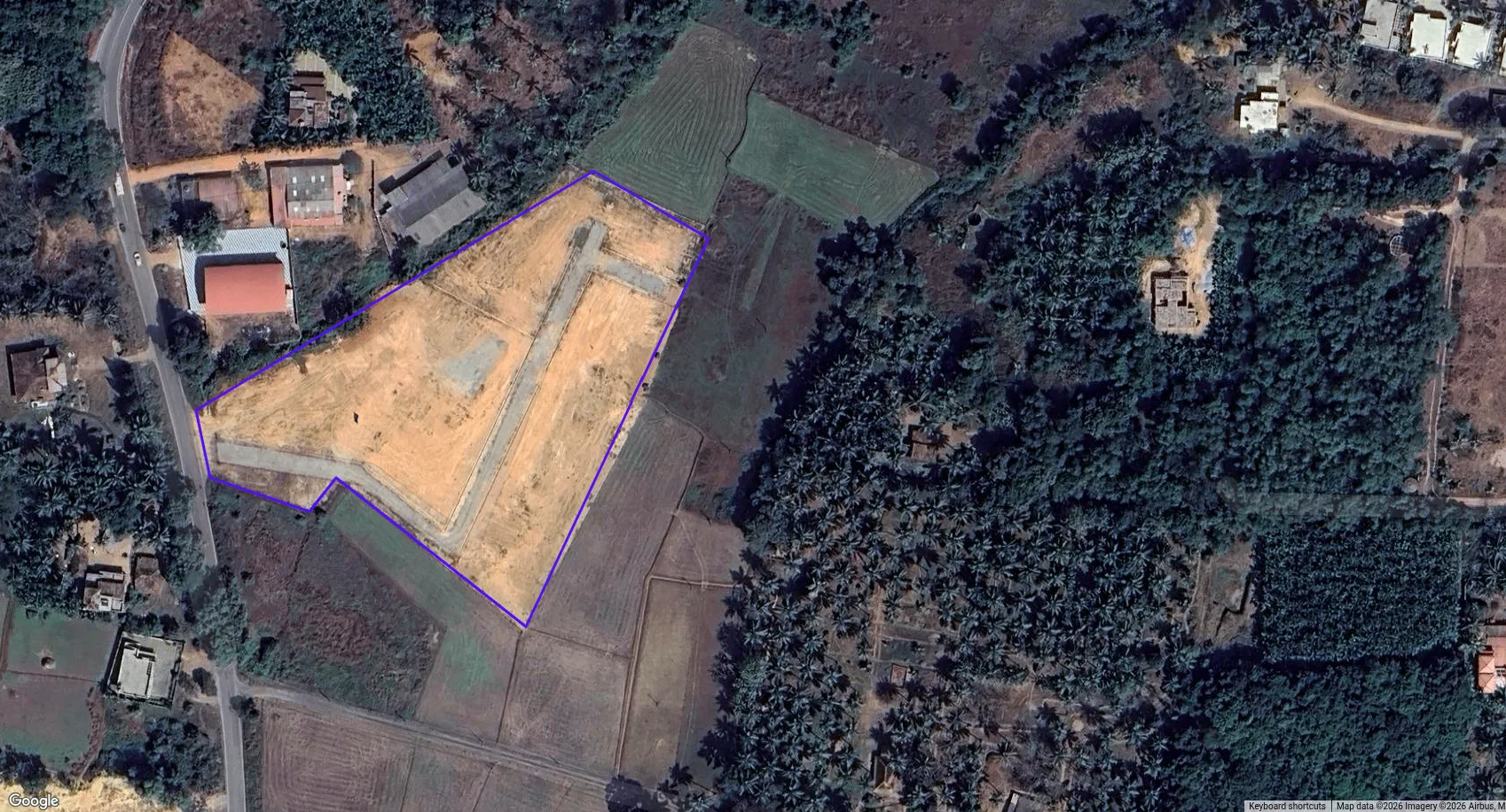
Coastal Karnataka has a specific quality of light, air, and greenery that is simply absent from most Indian cities — and quietly disappearing from the edges of Mangaluru and Udupi as construction intensifies. Saibrakatte is still inside that landscape. Coconut groves, areca plantations, paddy fields, and the gentle presence of the Western Ghats foothills define the visual world around you.
When you build a home here, you are not clearing a slab in a concrete grid. You are setting a house into a working agrarian landscape where the air is clean, water tables are decent, and the pace of life does not grind you down. The Karavali monsoon comes in full — lush, dramatic, and unlike anything in Karnataka's inland districts. And the dry season gives you the long golden evenings that people who grew up here carry with them for the rest of their lives, wherever they go.
This is not nostalgia. This is a real quality-of-life asset that diminishes the closer you build to a highway or a city edge. At Saibrakatte, it is still intact.
Land here can carry standing coconut, areca, and teak — generating agricultural income while you plan or build, making it productive from the day you purchase, not just the day you occupy.
When you build a home here, you are not clearing a slab in a concrete grid. You are setting a house into a working agrarian landscape where the air is clean, water tables are decent, and the pace of life does not grind you down. The Karavali monsoon comes in full — lush, dramatic, and unlike anything in Karnataka's inland districts. And the dry season gives you the long golden evenings that people who grew up here carry with them for the rest of their lives, wherever they go.
This is not nostalgia. This is a real quality-of-life asset that diminishes the closer you build to a highway or a city edge. At Saibrakatte, it is still intact.
Land here can carry standing coconut, areca, and teak — generating agricultural income while you plan or build, making it productive from the day you purchase, not just the day you occupy.